
Social media marketing has moved far beyond simply posting a picture and hoping people notice. Today, the platforms themselves are built around recommendation systems, short-form video, personalized feeds, social listening, and real-time engagement. Meta has even said that all new Facebook video uploads will soon be classified as Reels, and Instagram has rolled out a feature that lets users edit the topics the app thinks they like. That tells us something important: success on social media now depends on relevance, retention, and strong audience signals. Learn practical social media marketing, Meta Ads, and content strategy with the Digital Marketing Courses in Andheri.
This is why the old “post daily and use hashtags” approach is no longer enough. The strategies that work today are the ones that help your content get watched, shared, saved, discussed, and remembered. They also rely on analytics, social intelligence, community building, and a format-first mindset that matches how people actually use each platform now.
What social media marketing really means now
Modern social media marketing is not just content distribution. It is a combination of brand storytelling, community management, customer support, trend response, creator collaboration, and performance measurement. Discover how AI is transforming social media marketing in this guide on AI in Digital Marketing. Sprout Social’s current resources emphasize social intelligence, analytics, influencer marketing, employee advocacy, and moderation, which reflects how broad the role has become.
That shift matters because platforms do not reward noise; they reward signals. TikTok’s recommendation system quickly amplifies content aligned with user interests, while YouTube Shorts recommendation research shows that short-form systems can drift, filter, and prioritize engagement-heavy content. In other words, people and algorithms both respond to clarity, relevance, and pace.
1) Know your audience before you create anything
The strongest social media strategies begin with a clear audience profile. Before you post, you should know who you are speaking to, what they care about, what problems they want solved, and which platform they use for that purpose. Social media today is fragmented, so one message rarely works everywhere. Content that feels natural on LinkedIn often feels too formal on Instagram, while TikTok usually rewards faster, more direct, more personality-driven content.
A good audience strategy also includes listening. Sprout Social’s current focus on social listening and social data shows how important it is to study conversations, trends, and customer feedback instead of guessing. The brands that win on social media are usually the ones that understand what their audience is already saying.
2) Make short-form video your priority
If there is one format that dominates social media right now, it is short-form video. Meta is pushing Facebook video into the Reels format, and short video remains central to Instagram, TikTok, and YouTube Shorts. That does not mean every post must be a reel, but it does mean video should be a major part of your content mix.
The reason is simple: short-form video is built for fast attention. Research on TikTok shows that content aligned with user interests can be amplified very quickly, especially within the first stretch of viewing. That means the first few seconds of your video matter a lot. A slow introduction, weak visual opening, or unclear message can lose the viewer before your content has a chance to work.
3) Hook people immediately
A strong hook is one of the most practical strategies in social media marketing. Your first line, first frame, and first visual cue should tell people exactly why they should keep watching. On short-form platforms, viewers decide almost instantly whether to continue, so your content needs immediate clarity.
Hooks work best when they are specific. Instead of saying “Here are social media tips,” say “3 social media mistakes that quietly kill reach” or “The exact posting strategy that gets more saves.” Specificity creates curiosity, and curiosity keeps attention. That is the basic engine of effective social content.
4) Create content that fits the platform, not just the brand
One of the biggest mistakes brands make is copying the same post across every platform. Social media platforms are not interchangeable. Instagram is highly visual, Facebook is increasingly video-centered, TikTok favors fast, native-feeling content, LinkedIn rewards insight and authority, and YouTube works well for both short and long educational video.
Instagram’s algorithm controls also suggest that platform relevance is becoming more user-defined. People can now adjust the topics Instagram thinks they like, which means content must match the audience’s actual interests even more closely. The more your message feels native to the platform, the more likely it is to be received well.
5) Use social listening to join conversations at the right time
Social listening means paying attention to what people are talking about, what questions they are asking, and what issues are rising in your niche. This is one of the most useful social media strategies because it helps you make content that feels timely instead of random. Sprout Social’s recent editorial focus includes social intelligence, competitive analysis, and conversation analysis at scale, which shows how central listening has become to modern marketing teams.
The best social media brands do not only broadcast; they respond. They adapt their message to current conversations, customer pain points, and emerging trends. That is also how brands avoid sounding disconnected or overly promotional. Content becomes stronger when it feels like it belongs in the moment. Master social media marketing through live projects with the Digital Marketing Courses in Borivali.
6) Build a community, not just an audience
A follower count is not the same as a loyal community. Brands that perform well on social media usually create reasons for people to interact with them repeatedly. That can mean replying to comments, starting discussions, asking questions, using polls, featuring user-generated content, or turning customers into contributors. Sprout Social’s current emphasis on personalizing customer care and managing community conversations reflects how important this has become.
Community is powerful because it creates trust. People are more likely to stay connected to a brand that feels human and responsive than one that only pushes promotions. This is especially true in a crowded feed where users can scroll past hundreds of posts in minutes.
7) Use creators and influencers with real relevance
Influencer marketing still works, but only when the creator fits the product and the audience. The trend has shifted away from celebrity-style promotion toward more credible, niche, and community-aligned voices. Sprout Social’s current resource focus includes influencer marketing and relationship management, which is a strong sign that brands are treating creator partnerships as a serious strategic channel, not just a campaign add-on.
What matters most is trust. A smaller creator with a highly relevant audience often performs better than a larger creator with weak audience alignment. The partnership should feel natural, useful, and consistent with both the creator’s voice and the brand’s identity.
8) Don’t ignore employee advocacy and thought leadership
For B2B brands and professional services, employee advocacy can be one of the strongest social strategies available. Sprout Social includes employee advocacy as a core solution area, and LinkedIn’s feed infrastructure continues to evolve in ways that prioritize relevant content discovery and engagement. LinkedIn’s recent feed-ranking research even reports online gains in member engagement from its newer feed model.
That matters because people trust people more than logos. When employees, founders, and subject-matter experts share informed perspectives, the brand gains reach and credibility at the same time. Thought leadership works best when it is helpful, clear, and grounded in real experience rather than generic inspiration.
9) Measure the right metrics
A social media campaign is only successful if you can measure what changed. Likes alone do not tell the full story. You should look at reach, saves, shares, comments, watch time, click-through rate, profile visits, leads, conversions, and customer retention. Sprout Social’s current resources emphasize analytics, premium reporting, ROI, and social data, which is exactly the direction modern marketing teams are taking.
The point of measurement is not just to prove that content was seen. It is to understand what made people stop, watch, respond, and act. Once you know that, you can refine your strategy instead of guessing. That is where social media marketing becomes a repeatable system rather than random posting.
10) Keep testing and improving
The best social media marketers treat every post like a small experiment. They test different hooks, captions, thumbnails, video lengths, posting times, and calls to action. Research on social platforms shows that recommendation systems can amplify aligned content quickly, but they can also shift over time, so a winning format this month may not stay winning forever.
That is why consistency matters. Not just posting consistently, but testing consistently. You improve by comparing what performs, removing what does not, and repeating what works. Over time, your content library becomes smarter and more efficient.
A simple social media strategy that works
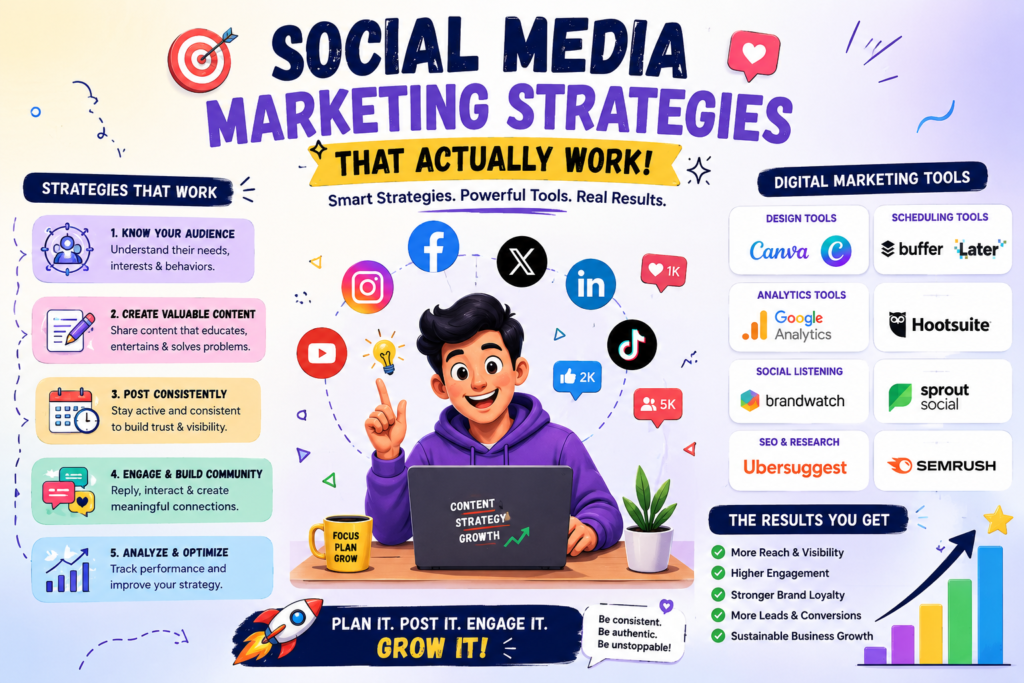
A practical strategy can be built around five steps. First, define your audience and the platform they use most. Second, choose one or two core content formats, such as reels, carousels, or thought-leadership posts. Third, publish consistently and make sure each post has one clear message. Fourth, listen to audience feedback and adapt quickly. Fifth, track results and improve based on engagement and conversion data. That kind of system aligns with current platform direction, where video, relevance, analytics, and community all matter more than ever.
Common mistakes to avoid
Many brands still fail on social media because they post without a goal, copy content across platforms without adapting it, ignore comments, chase every trend, or measure the wrong metrics. Another common mistake is making content that is too promotional and not useful enough. In a feed shaped by algorithms and user preferences, low-value content gets ignored quickly.
Another mistake is underestimating moderation and trust. Sprout Social’s current coverage of social moderation shows that brands now need systems to protect their reputation and maintain healthy communities. Social media success is not only about growth; it is also about creating a space people actually want to return to.
Conclusion
Social media marketing that actually works is built on relevance, speed, consistency, and trust. It uses short-form video wisely, starts with a strong hook, adapts content to each platform, listens to the audience, builds community, and measures real outcomes. The modern social landscape is shaped by recommendation engines, algorithmic feeds, creator culture, and ongoing platform changes, so brands that stay flexible and audience-focused will always have the advantage.
The brands that win are not the ones that post the most. They are the ones that understand their audience, create content people actually care about, and keep improving every week. That is what makes social media strategy effective in 2026 and beyond.