
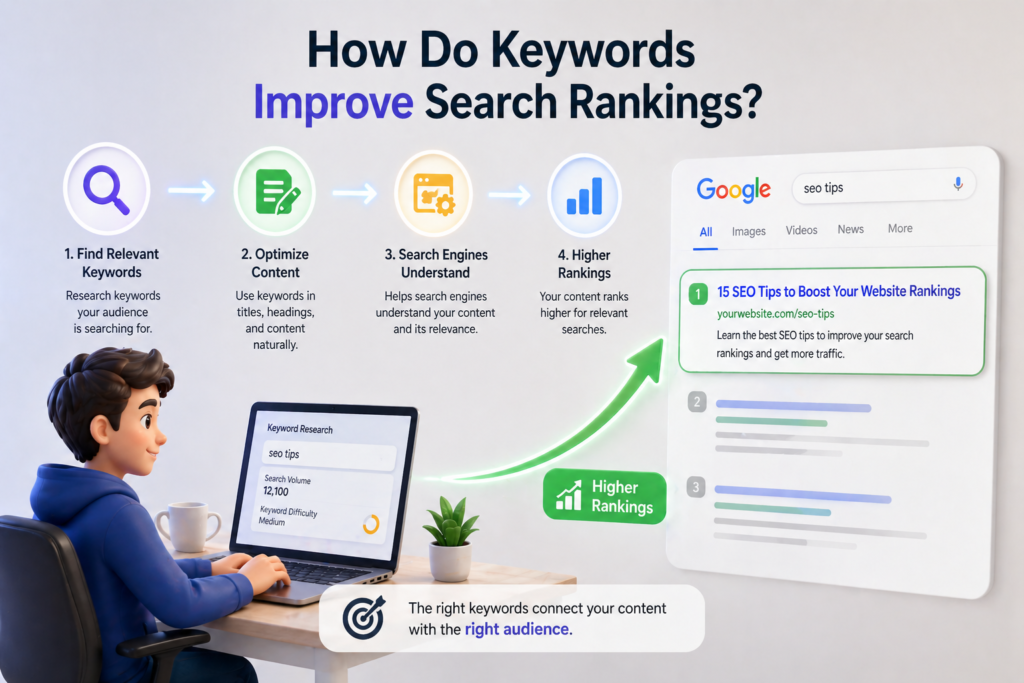
How Do Keywords Improve Search Rankings?
Keywords are the foundation of search engine optimization and one of the most important factors in improving search rankings. Using the right AI SEO tools can make keyword research and content optimization much easier. Explore these AI SEO Tools for Beginners. Every time someone searches online, they use words or phrases to find answers, products, services, or solutions. Those search terms are called keywords, and they play a major role in connecting users with relevant content. Without keywords, search engines would struggle to understand what webpages are about and how they should appear in search results.
In simple terms, keywords help search engines match a user’s search query with the most relevant pages available. When a website uses the right keywords strategically and naturally, search engines can better understand its content, rank it for relevant searches, and show it to people actively looking for that information. This is why keyword optimization is a critical part of any SEO strategy.
But keywords do far more than help pages rank. They improve relevance, strengthen content strategy, increase visibility, attract targeted visitors, and support long-term organic growth. When used properly, keywords do not just bring traffic—they bring the right traffic.
Understanding the Role of Keywords in SEO
Search engines are designed to provide users with the most accurate and helpful results for every search. To do this, they analyze countless web pages and determine which ones best match a user’s query. Keywords help search engines make those connections.
For example, if someone searches “how to improve website ranking,” search engines scan indexed pages to find content related to website rankings, SEO strategies, and optimization techniques. Pages containing relevant keyword signals, valuable information, and strong optimization have a better chance of appearing higher in results. A detailed competitor SEO analysis helps you discover the keywords your competitors are already ranking for.
This process shows why keywords are more than just phrases inserted into content. They act as signals that tell search engines what your content covers and why it may be relevant to a particular search.
1. Keywords Help Search Engines Understand Content
Search engines use keywords to analyze and understand the topic of a webpage. When relevant keywords are naturally included in page titles, headings, descriptions, and body content, they send clear signals about what the page covers. This helps search engines crawl and index the content properly. The clearer those signals are, the better the chances of the page appearing for related searches. Well-optimized keywords improve topic relevance and help search engines decide where your content belongs in search results.
2. Keywords Improve Search Relevance
Search engines prioritize showing users the most relevant content possible. Keywords improve rankings by making content align more closely with what users are searching for. When your content includes terms and phrases your audience actually uses, it becomes more likely to match those searches. This relevance increases the possibility of better rankings while also helping attract users who are genuinely interested in your topic, products, or services.
3. Keywords Match User Search Intent
Not every search has the same purpose, and keywords help businesses target those different intentions. Some people search for information, others compare options, and some are ready to make a purchase. Choosing keywords that align with these intentions allows content to better satisfy users. Search engines recognize when content meets search intent effectively, and that often contributes to stronger rankings, better engagement, and improved user experience.
4. Keywords Drive Targeted Organic Traffic
One of the biggest benefits of keywords is attracting the right audience instead of random visitors. Targeted keywords help bring users who are already interested in what you offer. This often results in higher engagement, lower bounce rates, and stronger conversion opportunities. Rather than focusing only on traffic quantity, keyword optimization helps improve traffic quality, which is even more valuable for long-term SEO success.
Types of Keywords and How They Help Rankings
5. Short-Tail Keywords
Short-tail keywords are broad search terms with high search volume and strong competition. They can help increase general visibility and brand exposure, especially for established websites. Although they can be harder to rank for, they often serve as foundation keywords within a broader SEO strategy. Businesses often combine these broad terms with more specific keywords to strengthen overall rankings.
6. Long-Tail Keywords
Long-tail keywords are more specific phrases that often have lower competition and clearer search intent. These keywords can be easier to rank for and often attract highly targeted visitors. Because they reflect specific user needs, they frequently lead to stronger engagement and conversions. Many successful SEO strategies rely heavily on long-tail keywords to build traffic and ranking opportunities over time.
7. Primary and Secondary Keywords
Primary keywords represent the main focus of a page, while secondary keywords support the topic and add context. Using both helps create well-optimized content that can rank for multiple related searches. This strengthens relevance and broadens the number of search opportunities a page can capture. Together, they help improve both focus and depth in SEO content.
8. Semantic and Related Keywords
Modern search engines do not rely only on exact-match keywords. They also analyze related and semantic terms to understand context. Including naturally related keywords helps improve topical relevance and makes content appear more comprehensive. This can strengthen rankings by signaling expertise and improving how search engines interpret your content.
Different Ways Keywords Improve Search Rankings
9. Keyword Research Strengthens SEO Strategy
Strong rankings begin with keyword research. Research helps identify what people are searching for, how competitive terms are, and where ranking opportunities exist. This allows businesses to create content around real demand rather than assumptions. A good keyword strategy often starts with understanding audience behavior and using that data to guide content decisions.
10. Keywords Improve On-Page SEO
Keywords improve on-page optimization when used in important elements such as titles, headings, meta descriptions, URLs, and internal links. These placements help search engines better understand page relevance while improving user experience. Well-optimized pages often perform better because both search engines and users can navigate the content more effectively.
11. Keywords Help Build Content Authority
Using keywords strategically across related content can help build authority around a topic. When a website consistently creates keyword-focused content in one niche, search engines may begin viewing it as a trusted source. Over time, this topical authority can support stronger rankings across multiple pages rather than just one piece of content.
12. Keywords Support Featured Search Results
Certain keyword phrases, especially question-based searches, can help content appear in featured snippets and other enhanced search results. These positions often receive strong visibility and can increase traffic significantly. Optimizing for these opportunities can strengthen search presence beyond traditional rankings.
Why Keywords Matter for SEO Growth
Keywords contribute to long-term growth in many ways. They improve discoverability, help attract qualified audiences, support stronger content strategy, and increase organic visibility. As content continues ranking over time, keywords can drive consistent traffic long after publication. This makes them one of the most sustainable elements of digital marketing.
Key Ways Keywords Improve Rankings
Keywords improve search performance through several important ways:
Better Search Engine Understanding
Keywords help search engines recognize what a page is about and when it should appear in results. This improves indexing, topic clarity, and ranking opportunities. Without strong keyword signals, even useful content may struggle to perform.
Improved Content Relevance
Relevant keywords align content with what users search for. This makes content more useful to both search engines and audiences, increasing ranking potential and engagement.
Stronger User Intent Matching
Intent-driven keywords help create content that answers user needs more effectively. When search intent and content align, rankings often improve.
Higher Quality Organic Traffic
Keywords help attract users who are actively looking for your solutions. This improves not only traffic volume but also traffic quality.
Greater Content Authority
Using keywords consistently across related topics strengthens topical expertise and helps build authority over time.
Common Mistakes to Avoid
While keywords are powerful, misuse can hurt rankings.
One common mistake is keyword stuffing—overusing keywords unnaturally in content. This can reduce readability and negatively impact SEO.
Another mistake is targeting only highly competitive keywords while ignoring easier long-tail opportunities.
Some businesses also focus on keywords without considering search intent, which often leads to traffic that does not convert.
Successful keyword optimization balances relevance, strategy, and content quality.
Conclusion
Keywords improve search rankings by helping search engines understand content, improving relevance, matching user intent, and driving targeted organic traffic. They are the foundation of SEO because they connect what users search for with the content businesses provide. Learn keyword research, on-page SEO, and advanced SEO strategies with the Digital Marketing Courses in Andheri.
From short-tail and long-tail keywords to keyword research, on-page optimization, and intent targeting, every part of a strong SEO strategy depends on effective keyword use. When businesses use keywords strategically rather than simply inserting terms into content, they improve visibility, attract the right audience, and create stronger opportunities for long-term growth.
In digital marketing, keywords are far more than search terms—they are the path that helps users discover valuable content and helps businesses achieve higher rankings online.