
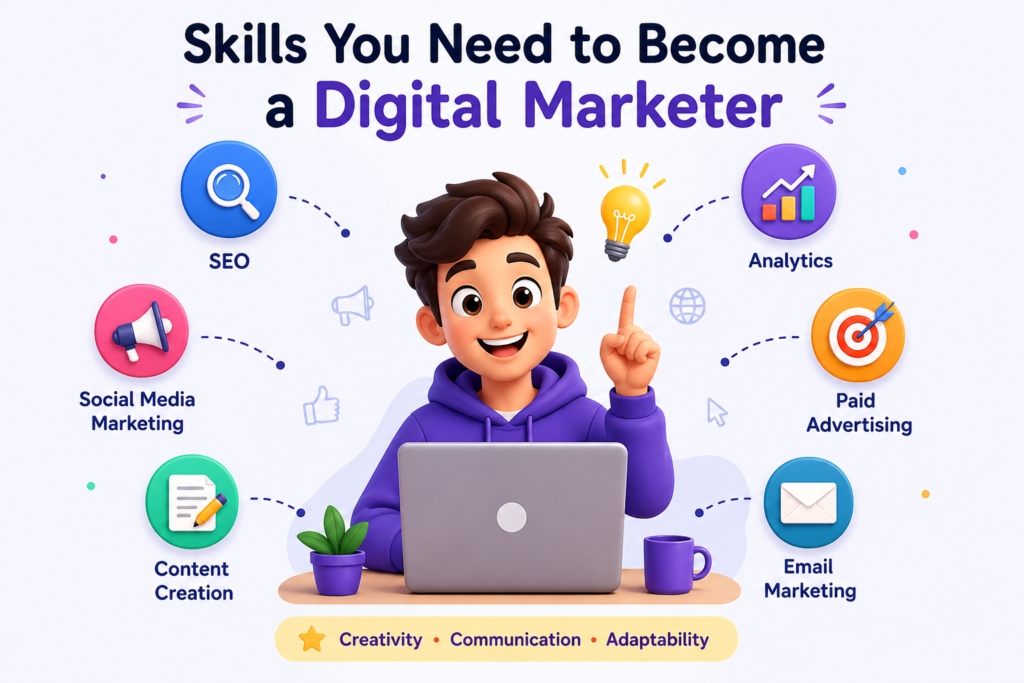
Digital marketing refers to the promotion of products or services using digital platforms such as search engines, social media, websites, email, and mobile applications. In today’s technology-driven world, businesses rely heavily on digital marketing to reach their target audience, build brand awareness, and increase sales. A digital marketer is a professional who plans and executes online marketing strategies using various tools and techniques. To succeed in this field, one needs a combination of creative, analytical, technical, and communication skills.
Detailed Explanation
To become a successful digital marketer, it is essential to first understand the fundamentals of marketing, such as customer behavior, target audience, branding, and the customer journey. These basics help in creating effective strategies rather than relying on guesswork. One of the most important skills is content creation and copywriting, as digital marketing largely depends on written and visual content like blogs, social media posts, advertisements, and emails. Explore the most in-demand skills in this guide on 10 Digital Marketing Skills to Learn. A marketer should be able to write clear, engaging, and persuasive content that attracts and converts audiences. Along with this, knowledge of Search Engine Optimization (SEO) is crucial, as it helps websites rank higher on search engines like Google and brings organic traffic. Social media marketing is another key area where marketers need to understand how different platforms work and how to create engaging content that connects with the audience.
In addition, paid advertising skills are important for running campaigns on platforms like Google Ads and social media, where marketers must manage budgets, target the right audience, and analyze performance. Data analysis plays a major role in digital marketing, as it allows marketers to measure results, understand user behavior, and improve strategies based on performance metrics such as clicks, conversions, and return on investment. Email marketing is also a valuable skill, helping businesses maintain relationships with customers through personalized messages and automated campaigns.
Basic design and video editing skills are helpful for creating visually appealing content, while knowledge of technical aspects like website management, HTML basics, and analytics tools enhances efficiency. Furthermore, understanding user experience (UX) and conversion rate optimization (CRO) helps improve website performance and increase customer actions. Build practical digital marketing skills with the Digital Marketing Courses in Mumbai. Communication and teamwork skills are equally important, as digital marketers often work with different teams and clients. Lastly, adaptability and continuous learning are essential because digital marketing trends and technologies keep evolving. A good digital marketer stays updated and continuously improves their skills to remain competitive.
Explanation of Key Skills Required for Digital Marketing
1. Understanding of marketing fundamentals and customer behavior
This is the base of digital marketing. It involves understanding who your target audience is, what they need, what problems they face, and how your product or service can solve those problems. It also includes knowledge of concepts like branding, positioning, and the customer journey (awareness, consideration, decision). Without this understanding, marketing efforts can become ineffective and unfocused.
2. Content writing and copywriting skills
Content writing focuses on creating informative and engaging content such as blogs, articles, and social media posts. Copywriting, on the other hand, is about writing persuasive content that encourages people to take action, like clicking a link or buying a product. A digital marketer must know how to write clearly, creatively, and according to the audience’s needs.
3. Search Engine Optimization (SEO) knowledge
SEO is the process of improving a website’s visibility on search engines like Google. It includes keyword research (finding what people search for), on-page optimization (titles, headings, content), and technical aspects like website speed and mobile friendliness. Good SEO helps bring free and consistent traffic to websites.
4. Social media marketing skills
This skill involves promoting brands on platforms like Instagram, Facebook, LinkedIn, and Twitter. It includes creating posts, engaging with followers, understanding trends, and analyzing performance. A digital marketer must know how to use each platform differently and build a strong online presence.
5. Paid advertising (Google Ads, Meta Ads, etc.)
Paid advertising allows businesses to reach a large audience quickly. It involves creating ads, selecting target audiences, setting budgets, and analyzing results. Marketers must understand metrics like cost per click (CPC) and return on investment (ROI) to ensure campaigns are effective.
6. Data analysis and interpretation
Digital marketing is based on data. This skill involves analyzing numbers such as website traffic, clicks, conversions, and engagement rates. Tools like Google Analytics help marketers understand what is working and what needs improvement. It helps in making informed decisions instead of guessing.
7. Email marketing and automation
Email marketing involves sending messages to customers to promote products, share updates, or build relationships. Automation tools allow marketers to send emails automatically based on user behavior. This helps save time and improves communication with customers.
8. Basic design and video editing skills
Visual content is very important in digital marketing. Basic design skills help in creating attractive posts, banners, and ads using tools like Canva. Video editing skills are useful for creating engaging content like reels, shorts, and promotional videos, which are very popular today.
9. Technical knowledge (HTML, websites, tools)
A digital marketer should have basic technical knowledge, such as how websites work, how to use platforms like WordPress, and basic HTML. This helps in managing websites, fixing small issues, and working efficiently with developers.
10. Conversion Rate Optimization (CRO) and User Experience (UX)
CRO focuses on improving the percentage of users who take action (like signing up or buying). UX ensures that the website or app is easy to use and user-friendly. A good digital marketer improves layouts, content, and design to make the user experience smooth and effective.
11. Communication and teamwork skills
Digital marketers often work with teams, clients, and other departments. Good communication helps in sharing ideas clearly, understanding requirements, and working efficiently. Teamwork is important to successfully execute marketing campaigns.
12. Creativity and problem-solving ability
Creativity helps in making unique and engaging content that attracts attention. Problem-solving is needed when campaigns do not perform well. A marketer must analyze the issue and find better strategies to improve results.
13. Adaptability and continuous learning mindset
Digital marketing is always changing due to new technologies, trends, and algorithms. A good marketer must stay updated, learn new tools, and adapt to changes. Continuous learning helps in staying competitive in this fast-growing field.
1. Core Marketing Fundamentals
Before diving into tools and platforms, you need a solid understanding of how marketing works.
This includes:
- Understanding customer behavior (why people buy)
- Knowing how to identify a target audience
- Learning the customer journey (awareness → consideration → conversion → retention)
- Grasping value propositions and branding
Without this foundation, running ads or posting on social media becomes guesswork instead of strategy.
2. Content Creation Skills
Content is the backbone of digital marketing. You’ll need to know how to create content that attracts, informs, and converts.
Important areas:
- Copywriting: Writing persuasive headlines, ads, emails, and landing pages
- Blog writing: Informational, SEO-friendly articles
- Visual content: Basic design using tools like Canva
- Video content: Short-form videos (Reels, TikTok, YouTube Shorts)
You don’t need to be a professional designer or filmmaker, but you should be able to communicate ideas clearly and creatively.
3. Search Engine Optimization (SEO)
SEO helps websites rank higher on Google and bring in organic (free) traffic.
Key aspects:
- Keyword research (finding what people search for)
- On-page SEO (titles, meta descriptions, content optimization)
- Technical basics (site speed, mobile friendliness)
- Link building
SEO is a long-term game, but it’s one of the most valuable skills in digital marketing.
4. Paid Advertising (PPC)
Paid ads can drive immediate traffic and sales. You should understand how to run and manage campaigns.
Common platforms:
- Google Ads
- Facebook/Instagram Ads
- LinkedIn Ads
- YouTube Ads
Skills involved:
- Budget management
- Audience targeting
- A/B testing
- Writing ad copy
- Performance tracking
5. Social Media Marketing
Social media is not just posting—it’s about building a brand and engaging with an audience.
You need to know:
- Platform differences (Instagram vs LinkedIn vs TikTok)
- Content strategy and consistency
- Engagement tactics (comments, DMs, communities)
- Analytics and growth tracking
6. Data Analytics & Interpretation
Digital marketing is highly data-driven. You must be comfortable reading numbers and making decisions based on them.
Tools and concepts:
- Google Analytics
- Conversion tracking
- Click-through rate (CTR)
- Return on investment (ROI)
This skill separates average marketers from high-performing ones.
7. Email Marketing
Email remains one of the highest ROI channels.
You should learn:
- Building email lists
- Writing effective subject lines
- Creating automated campaigns (funnels)
- Segmenting audiences
Tools like Mailchimp, ConvertKit, or HubSpot are commonly used.
8. Basic Technical Skills
You don’t need to be a developer, but some technical understanding helps a lot.
Useful skills:
- Basic HTML/CSS
- Website platforms (WordPress, Shopify)
- Understanding how tracking pixels and cookies work
This helps you troubleshoot problems and collaborate with developers.
9. Strategic Thinking
Many beginners focus too much on tools and tactics. Strategy is what ties everything together.
This means:
- Setting clear goals (traffic, leads, sales)
- Choosing the right channels
- Allocating budget wisely
- Planning campaigns
Without strategy, even good execution won’t deliver strong results.
10. Communication & Collaboration
Digital marketers often work with designers, developers, clients, or teams.
You need:
- Clear communication
- Ability to present ideas
- Basic project management skills
11. Adaptability & Continuous Learning
Digital marketing changes constantly—algorithms, platforms, trends.
To stay relevant:
- Follow industry blogs and updates
- Experiment with new tools
- Learn from data and mistakes
12. Creativity + Problem Solving
You’ll often face challenges like low engagement or poor ad performance.
You need to:
- Think creatively to stand out
- Test new ideas
- Solve problems quickly
Conclusion
In conclusion, becoming a digital marketer requires a combination of multiple skills rather than expertise in just one area. It is a dynamic and fast-growing field that demands both creativity and analytical thinking. Learn how AI is becoming an essential skill in this guide on AI in Digital Marketing. By building a strong foundation in marketing, learning practical tools, and continuously updating knowledge, anyone can develop a successful career in digital marketing. With consistent practice and real-world experience, these skills can help individuals create effective strategies, reach the right audience, and achieve business goals in the digital world.